
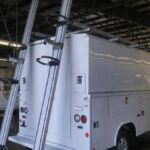
Aluminium ladder racks for KUV bodies
29 November 2025
Why invest in an aluminium ladder rack?
4 December 2025
Ladder racks for heavy duty pickup trucks
Heavy-duty pickup trucks like the Ford F-250, Ram 2500, Chevy Silverado 2500, and GMC Sierra 2500 make up the bulk of the commercial fleets operating in the United States and Canada. These types of trucks are commonly operated by construction companies and contractors; utility companies; facility maintenance operations; pest control companies; HVAC service providers; and many other operational areas that require high levels of performance on a regular basis. Due to their larger engines and higher towing capabilities, these heavy-duty vehicles are distinguishable from both light-duty and recreational models of pickup trucks. In addition, due to their low overall height (approximately 79 to 82 inches) they will remain lower than full van and/or truck applications using KUV body configurations or fully enclosed cargo systems.
This low profile provides a benefit to mounting equipment on roofs, however, it does highlight a pressing need for these fleets: to move heavy ladders above the cab and bed of the vehicle to provide increased storage capacity within the bed area for tools, supplies, etc. This can be especially important for those who use large fiberglass ladders, which require non-conductive materials at all points on the ladder to ensure worker safety during the application process. Gaining this interior space back will serve as a tangible means of increasing daily productivity while still maintaining the basic characteristics of the truck as a workhorse.
Basic rack designs and/or simple metal crossbar assemblies with ratcheting straps will suffice for smaller lighter loads—such as aluminum ladders that weigh less than 20 lbs., short extension ladders or step ladders—due to the height of the truck allowing for relatively easy manual lifting without excessive physical stress. However, when dealing with heavier fiberglass ladders that exceed 20 to 24 feet in length and typically weigh 60 to 80 lbs. to guarantee electrical insulation, the level of physical exertion required to manually lift these ladders exceeds that associated with simply applying force to complete a task, thus creating the potential for serious injury.
In order to reduce musculoskeletal concerns, NIOSH guidelines stress this threshold and suggest limits at about 51 pounds under ideal circumstances, modified downward for frequency, reach, or asymmetry. More than 600,000 back and shoulder injuries occur yearly in the US alone, accounting for over $50 billion in costs, including an average workers’ compensation settlement of $40,000 to $80,000 per back claim. These statistics hit the construction and material handling industries the hardest, where sprains and strains account for 30 percent of occurrences. The result is a loss of productive time and compensation controversy that no company wants to experience. Beyond inefficiency, safety, too, is an issue since lifting such weights impacts the shoulders and spine, also placing a skilled labor force at a disadvantage and raising insurance costs. There is an emotional toll, too; it is not easy to see a reliable crew member flinch from an unnecessary lift and silently foster the determination to upgrade equipment. Ladder racks stand out here as basic improvements that convert dangerous ascents to controlled operations and, with lower lift heights and supported mechanisms, fit the guidelines of NIOSH as well.
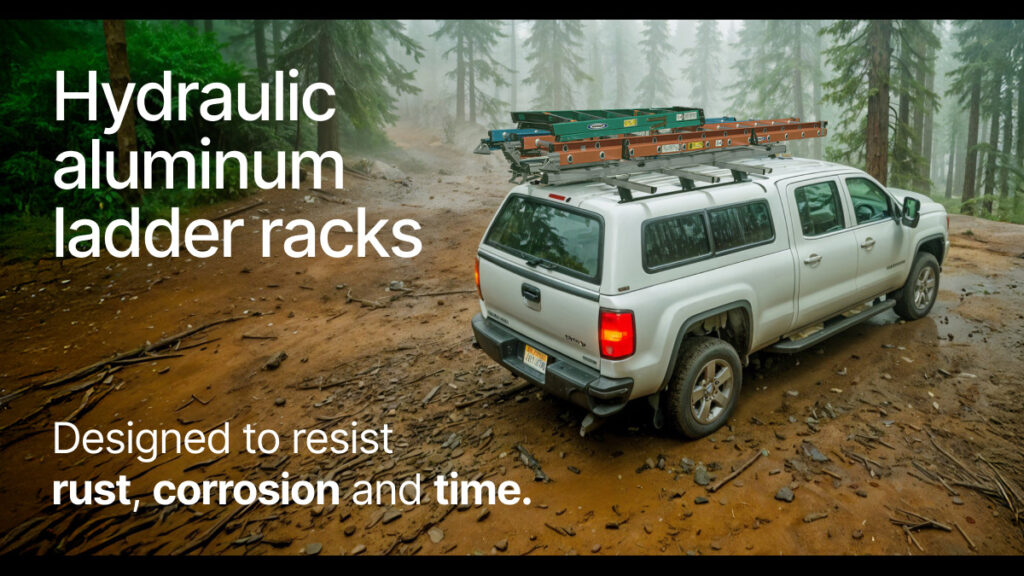
Key selection criteria include load capacity in lbs, user-friendly deployment, compatibility across truck beds and diverse ladder types like extensions or steps, hydraulic assistance options, material durability—ideally anodized aluminium or stainless steel for rust resistance—and robust warranties that promise longevity under harsh conditions. Among solutions, the G2000 Harrier and G2000 Maxi ladder racks stand out for heavy duty pickup trucks, delivering hydraulic-assisted performance tailored to demanding fleets. The G2000 Harrier handles single ladders up to 44 feet long and 132 lbs with servo-assisted dampers that lower the slide smoothly to ground level, enabling effortless loading without roof climbs or awkward heaves. Operators secure the ladder via adjustable retainers clad in protective sheaths, plus fastening belts and impact-resistant ABS stops on front and rear crossmembers, ensuring stability at highway speeds. Its anodized aluminium build, reinforced brackets and stainless-steel bolts defy weather and corrosion, fitting any truck via factory holes—no drilling required—while TÜV GS certification underscores its safety pedigree born from Italian engineering precision. Elevating versatility, the G2000 Maxi accommodates dual ladders side by side, matching the Harrier’s smooth hydraulic action for loads to 132 lbs total, with paired retainers, straps and adjustable stops preventing shifts. This dual capacity proves invaluable for HVAC teams or contractors juggling extension and step ladders, maximizing payload without sacrificing security or ease. Both models cut air resistance through aerodynamic profiles, minimizing fuel drag and noise, a subtle win for cost-conscious operators logging serious miles. Picture the relief at day’s end: ladders stowed securely, crew intact, ready for tomorrow’s calls— that’s the quiet confidence these racks instill. Ladder racks for KUV bodies integrate seamlessly on heavy duty pickups retrofitted with KUV enclosures, where bed space shrinks further, demanding overhead solutions that preserve access. Ladder racks for KUV setups prioritize universal mounting, often clamping to existing rails or bodies without permanent mods, vital for fleets rotating trucks. Ladder racks for KUVs excel in these confined profiles, supporting fiberglass giants that electricians or utility crews rely on, their non-conductive rungs a non-negotiable for live-line work. The G2000 series shines here, too, as their adjustable widths handle varied ladder dimensions, from compact steps to 24-foot-plus extensions, while hydraulic assist keeps lifts NIOSH-compliant by angling loads ergonomically close. Durability defines commercial value, and aluminum-stainless combos in these racks resist those salt-spray coasts or dusty plains that chew through lesser metals. Weighing less than their steel rivals, they boost mpg subtly-a nod to operational thrift amid rising fuel costs. Warranties back this resilience, often spanning years with minimal upkeep, letting managers focus on jobs, not repairs. Hydraulic systems, powered by truck batteries or standalone pumps, deploy in seconds and slash load times from minutes to moments-time that compounds across a fleet of 100-plus vehicles.
Universal fit spans Ford F-250 Super Duty beds to Ram 2500 crews, Silverado 2500HD long boxes or Sierra 2500 double cabs, adapting via modular clamps that grip diverse cab-roof junctions. This flexibility suits contractors scaling from solo ops to enterprise fleets, where standardization cuts training and inventory hassles. For pest control vans morphed into KUV bodies, ladder racks for KUV body configurations ensure tall fiberglass reachers stow flat, avoiding overhang fines or wind sway. HVAC pros carrying duct ladders appreciate the lockable options, like the G2000’s stainless ladder lock, thwarting theft on unsecured sites. NIOSH integration goes deeper: by dropping ladders to waist height, these racks slash the vertical lift factor in the equation, keeping the lifting index below 1.0 even for 80-lb loads. Facilities managers note fewer incidents post-install, correlating to dipped comp rates—real savings beyond the upfront. Emotional payoff? Crews trust the gear, morale holds steady, turnover dips. In construction, where overexertion claims 33% of injuries, such tools rewrite risk profiles. Beyond singles, ladder racks for KUVs handling multiples—like G2000 Maxi—cater to utility linemen stacking poles alongside ladders, capacities hitting 132 lbs without flex. Step ladders nest securely, their folded profiles no issue for retainer spans. Extension ladders deploy first rung low, minimizing spine torque. Stainless hardware weathers de-icing chemicals, a must for Canadian winters. Fleet buyers eye ROI: a rack paying for itself in one avoided claim, plus faster turns. For 100-vehicle orders, bulk engineering ensures consistent installs, perhaps customized for KUV integrations. Aerodynamics trim drag coefficients, extending range on diesel haulers. Ground clearance stays optimal post-mount, critical for rough-site access. Safety locks engage automatically, belts ratchet tight with minimal effort. Operators-even fatigued-manage solo, empowering smaller teams. In pest control, ladder/sprayer combos are typical; ladder racks for KUV bodies keep decks clear for tanks. Utility firms find value in non-conductive compatibility, racks cradle without scratching. G2000 Harrier’s central tilting mechanism pivots with ease, hydraulic cylinder metering out the descent to prevent slamming. Maxi mirrors the same function for twins, retainers sliding into place precisely. Both resist vibration, cross-members flexing minimally under 132-lb peaks. Commercial fleets thrive on this sort of reliability. Construction contractors cut downtime, and HVAC techs finish their routes a little fresher. Facilities teams maintain uptime. The racks’ Italian design-A DI-indexed for excellence at work-blends form and function seamlessly. These ladder racks for heavy-duty pickup trucks don’t just carry loads-they safeguard futures, one secure lift at a time.